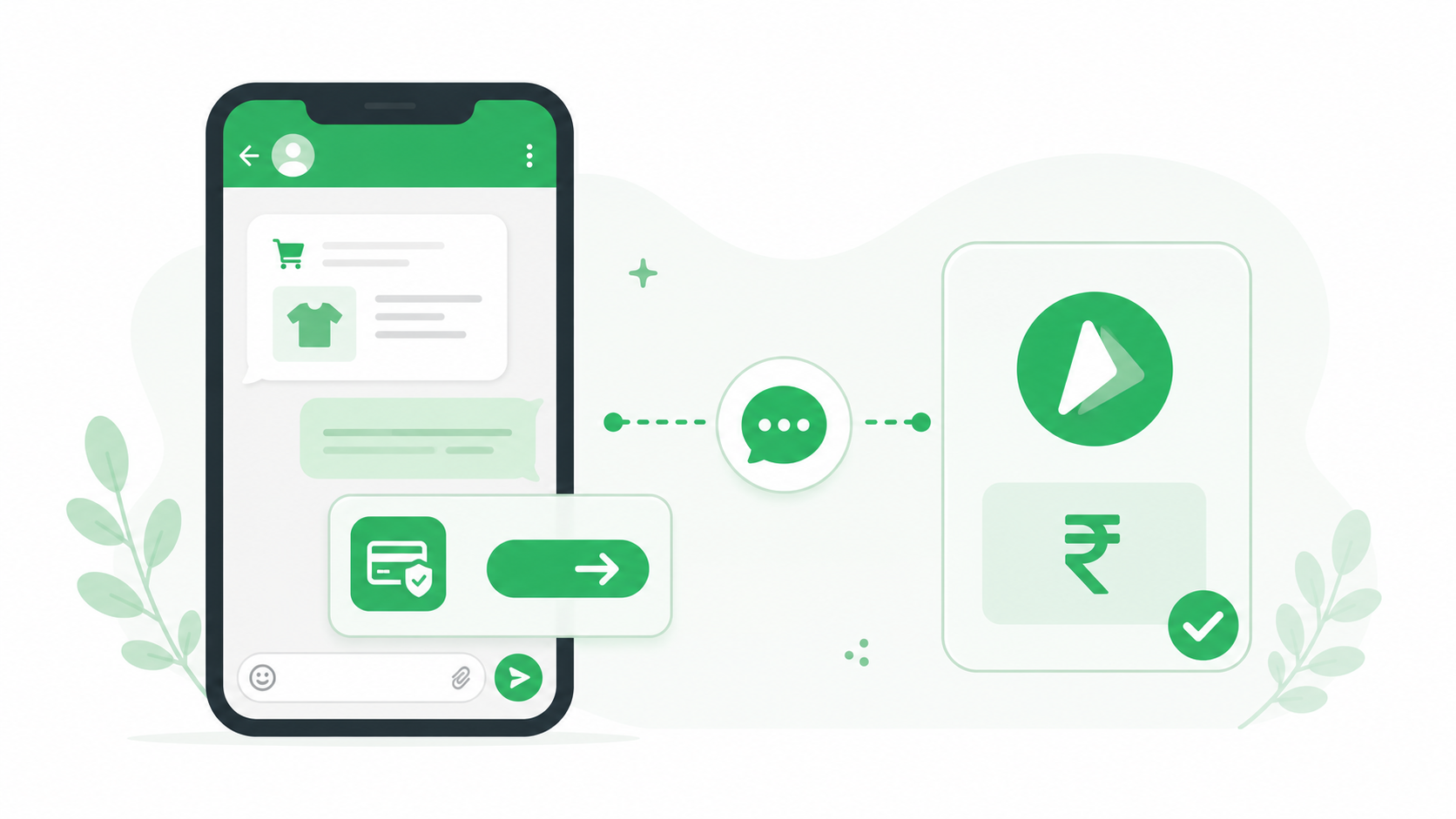
The Complete Guide to A/B Testing WhatsApp Marketing Campaigns
WhatsApp has become one of the highest-engagement marketing channels available, with open rates that regularly outperform email and SMS. But sending messages isn’t the same as sending the right messages. Two brands can broadcast to identical audiences and see wildly different results, and the difference almost always comes down to testing.
If you’re still picking one message, sending it to your entire list, and hoping for the best, you’re leaving conversions on the table. This guide covers everything you need to a/b test WhatsApp marketing campaigns properly, from the fundamentals to broadcast-specific testing to e-commerce campaigns built around cart recovery and conversion so you can turn results into a repeatable system rather than one-off experiments.
What Is A/B Testing in WhatsApp Marketing?
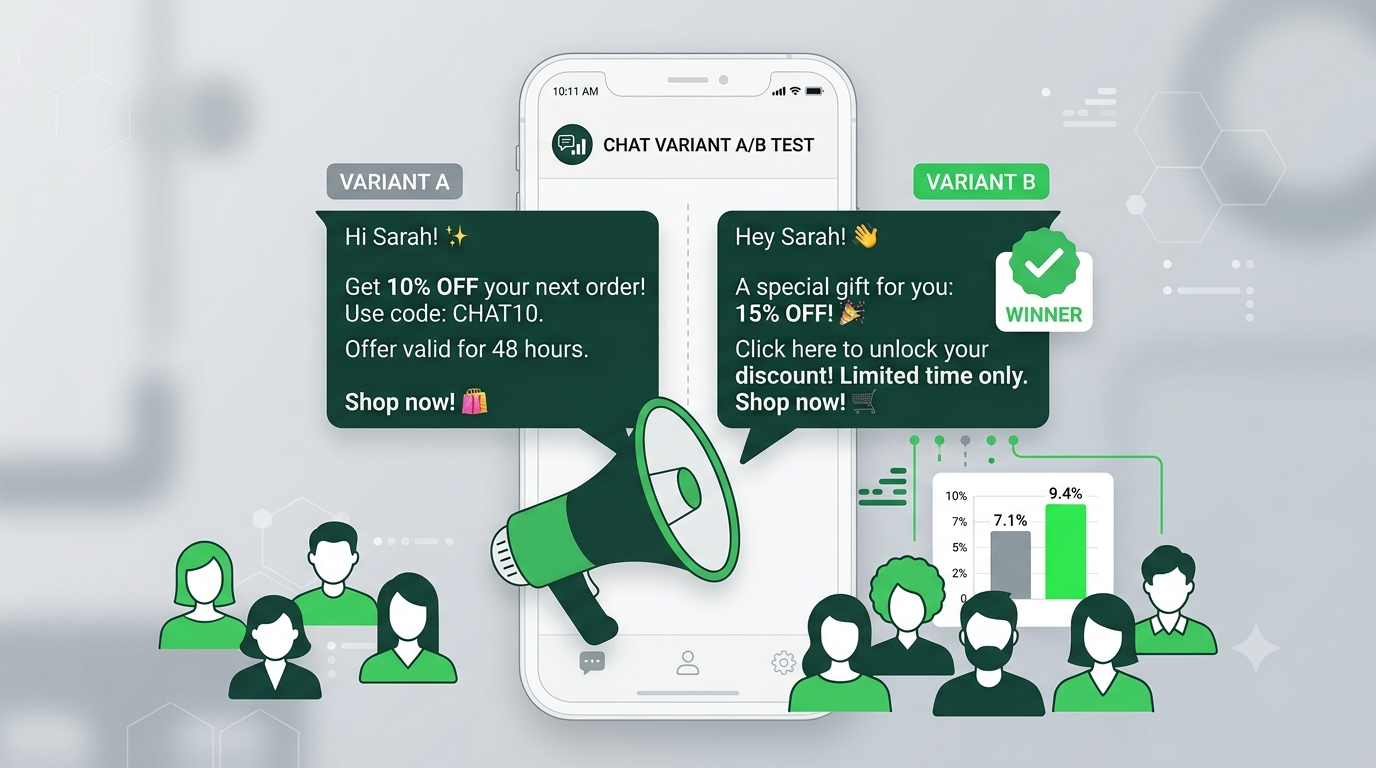
A/B testing (also called split testing) means sending two or more variations of a WhatsApp message to different segments of your audience, then measuring which version performs better against a specific goal: opens, clicks, replies, or purchases. Instead of guessing what your audience responds to, you let real behaviour tell you.
Why A/B Testing Matters for WhatsApp Campaigns
WhatsApp is a permission-based channel. Customers opt in expecting relevance, and every irrelevant or poorly timed broadcast increases the risk of an opt-out or a block. A/B testing protects that relationship by ensuring every campaign you scale has already proven itself on a smaller sample. It also compounds over time: each test teaches you something about your audience that improves the next campaign and the one after that.
For businesses running frequent promotions, festive sales, restocks, and order updates, this is especially valuable, since even a 5–10% lift in click-through rate on a high-volume broadcast translates into a meaningful number of additional conversions.
Key Elements You Can A/B Test in Any WhatsApp Campaign
Not everything is worth testing at once. Start with the elements that have the biggest impact on outcomes.
Message Copy and Tone
The wording of your opening line often decides whether a customer keeps reading or archives the chat. Test a direct, benefit-led opener against a more conversational, curiosity-driven one. For regional audiences, testing Hinglish or vernacular phrasing against pure English copy frequently reveals surprising engagement differences.
Call-to-Action (CTA) Variations
Your CTA is where intent turns into action. Testing different CTA phrasing (“Shop Now” vs. “Claim Your Offer”) can shift click-through rate significantly.
Button CTAs vs Text CTAs
WhatsApp Business API supports interactive buttons (quick reply and call-to-action buttons) alongside plain text links. Buttons typically reduce friction and improve tap rates, but text CTAs can feel more personal in relationship-driven categories like BFSI or healthcare. Testing both against your specific audience is the only way to know which wins for your brand.
Send Time and Frequency
The best time to send WhatsApp marketing messages varies by industry and audience behaviour a B2B audience may respond best mid-morning on weekdays, while a D2C retail audience often engages more in the evening. Run the same message at two different send windows and compare open and reply rates before locking in a schedule.
Media vs Text-Only Messages
Images, product carousels, and short videos can boost engagement, but they also increase message weight and load time on slower connections. Test a media-rich version against a lean text-plus-link version to see which actually drives more clicks for your specific product category.
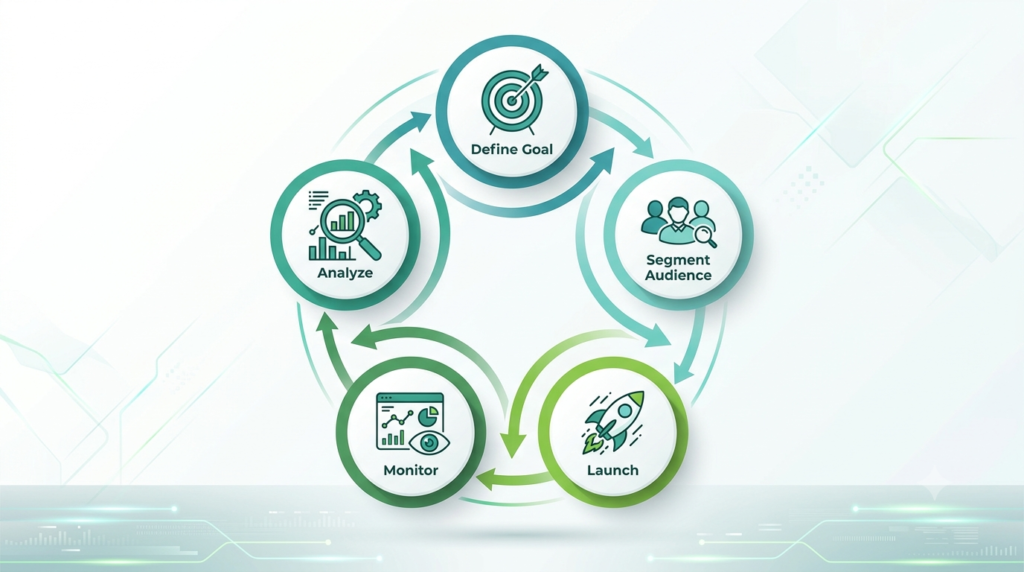
The Step-by-Step Process to Run a WhatsApp A/B Test
Step 1 – Define Your Goal and Hypothesis
Before writing a single message, decide what “winning” looks like: higher open rate, more clicks, more replies, or more completed purchases. Write a simple hypothesis, such as “A message with a discount code in the first line will get more clicks than one with the discount mentioned later.”
Step 2 – Segment Your Audience
Split your broadcast list randomly into equal-sized groups so results aren’t skewed by audience differences. For statistically meaningful results, most brands need at least a few hundred contacts per variant; smaller lists can still test, but should treat results directionally rather than definitively.
Step 3 – Choose the Right WhatsApp CRM/Platform
Manually splitting and tracking lists in spreadsheets doesn’t scale. This is where using the best WhatsApp CRM for your business matters a platform that can automatically segment contacts, send variant messages, and report on results without manual reconciliation. Look for a best CRM for WhatsApp setup that supports built-in split-testing workflows rather than requiring you to piece one together with third-party tools.
Why Choosing the Right WhatsApp Business API Partner Matters
Not every provider offers the same level of testing infrastructure. A reliable WhatsApp Business API partner gives you verified sender numbers, template approval support, and delivery analytics that are essential for trusting your test results. If your delivery rates are inconsistent between variants, your test data becomes unreliable so partner quality is a testing prerequisite, not an afterthought.
Step 4 – Launch and Monitor
Send both variants at the same time (or the same relative time, if you’re testing send-time itself) to avoid external factors like time-of-day or day-of-week skewing results. Monitor delivery, read receipts, and click data as it comes in, but resist the urge to call a winner too early early data is often misleading.
Step 5 – Analyze Results and Scale
Once you’ve reached a meaningful sample size, compare your variants against the goal metric you defined in Step 1. Roll the winning variation out to your full list, and archive the losing variant along with your notes this becomes a growing playbook of what works for your specific audience.
A/B Testing WhatsApp Broadcast Messages Specifically
The steps above apply broadly, but broadcast messaging deserves its own closer look. Broadcasts differ from one-on-one conversations in an important way: you get one shot per send. Unlike a chatbot flow you can tweak in real time, a broadcast message is locked the moment it’s sent to your list, which makes pre-send testing far more valuable here than almost anywhere else in your WhatsApp strategy.
Untested broadcasts risk three things at once: lower engagement, higher opt-out rates, and for businesses using an online bulk WhatsApp sender, potential quality-rating penalties from WhatsApp itself if a message underperforms badly enough. Testing on a smaller segment first protects both your metrics and your sending reputation.
Message Template Testing
If you’re using WhatsApp Business API, your message templates go through Meta’s approval process, which means iterating quickly requires having a few pre-approved template variants ready to test against each other. Building this library in advance is one of the most overlooked parts of message template testing teams that wait to write templates after deciding to test lose days to the approval queue.
Structuring Templates for Faster Approval
Keep variable placeholders simple, avoid promotional language in header sections, and align each template to a clear category (marketing, utility, or authentication) so Meta’s review process doesn’t flag it for reclassification. Templates that pass review quickly give you more room to test iteratively.
CTA Placement and Wording
Whether your CTA is a reply-based prompt, a button, or a link, where you place it in the message body affects results as much as the wording itself. Test a CTA placed immediately after the hook versus one placed at the end of a short explainer.
Broadcast List Segmentation
Broadcast list segmentation testing means comparing how the same message performs across different audience slices: new customers vs. repeat customers, high-value vs. low-value segments, or geography-based groups. A message optimised for one segment rarely performs identically across all of them, so segment-level testing often reveals more than copy testing alone.
Send Frequency and Cadence
Testing how often you can message a list without triggering fatigue is just as important as testing message content. Run one segment on a weekly cadence and another on a biweekly cadence over a month, then compare not just click-through rate but opt-out rate over the full period.
Personalization Depth
Testing message personalisation comes down to comparing generic broadcasts against ones that pull in a first name, past purchase category, or location. Deeper personalisation usually improves engagement, but it also requires cleaner CRM data, so this test often doubles as a data-quality audit.
Measuring Results: Which Metrics Actually Matter
- Delivery rate confirms your bulk sending infrastructure and template quality are solid before you even look at engagement.
- Open/read rate is a baseline signal of subject line and timing effectiveness.
- Click-through rate is the strongest early indicator of message and CTA effectiveness.
- Reply rate is especially relevant for conversational campaigns, service updates, or lead-gen flows.
- Opt-out rate: the metric most teams undertrack and the one most likely to catch a “winning” variant that’s quietly damaging list health.
- Conversion rate: the metric that ultimately matters most, tying testing results back to revenue rather than engagement alone.
Once you’ve identified a winner on a sample, send it to the remainder of your list and record the result in a shared testing log. Over time, this log becomes your team’s reference for what works for your specific WhatsApp business marketing campaign strategy, reducing the need to re-test the same variables repeatedly.
A/B Testing WhatsApp Campaigns for E-commerce and Conversions
For e-commerce brands, WhatsApp isn’t just another notification channel; it’s increasingly where purchase decisions actually happen, from cart recovery nudges to order confirmations to post-purchase upsells. Unlike a general awareness campaign, e-commerce WhatsApp messages are usually tied to a specific moment in the customer journey. That means the test isn’t just “Which message performs better?” but “Which message moves someone closer to completing a purchase at this exact point in their journey?” Framing your tests around funnel stage, rather than message type alone, leads to far more actionable results.
Abandoned Cart Message Testing
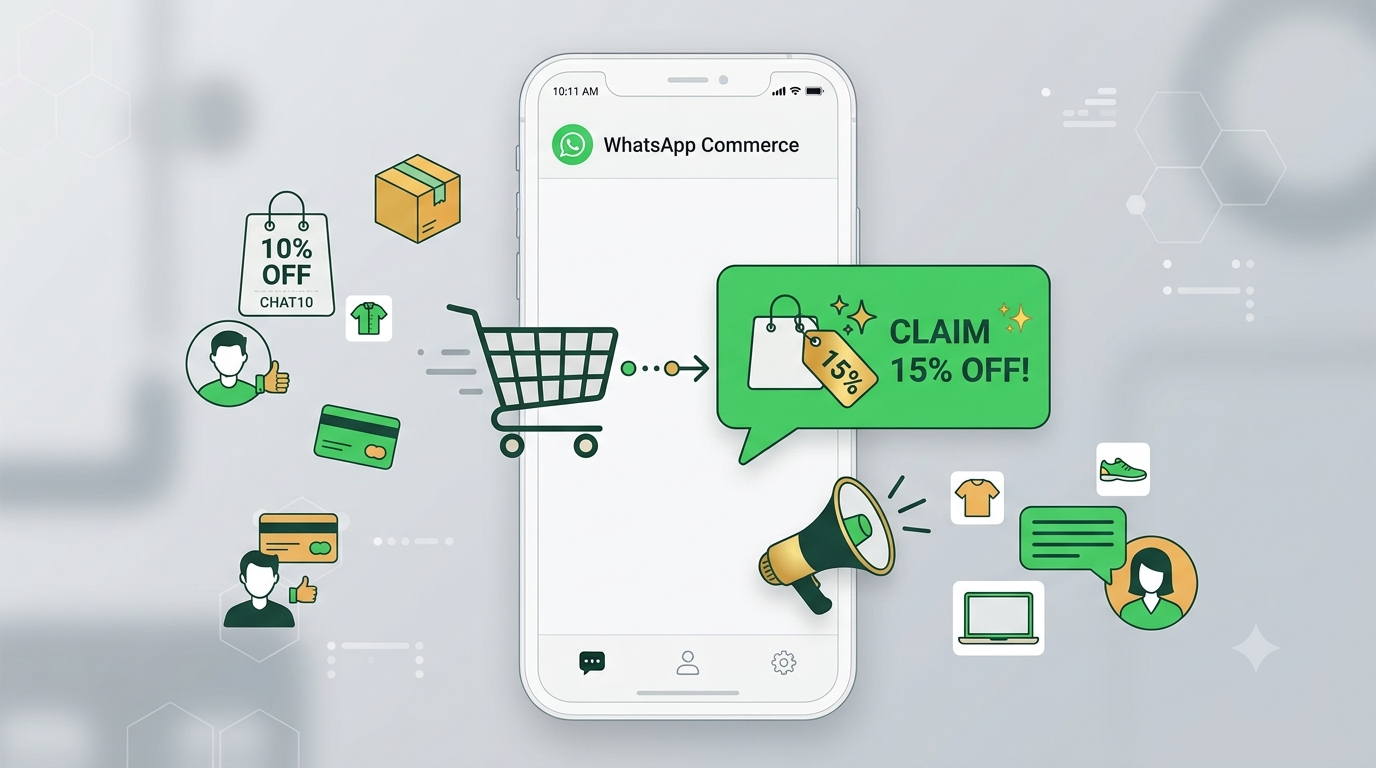
Cart abandonment recovery is one of the highest-ROI use cases for WhatsApp in e-commerce, but the message itself needs testing. Try a simple reminder (“You left something in your cart”) against a version with a small incentive (“Complete your order and save 10%”). Incentive-based messages often convert better, but they also erode margin, so it’s worth testing the smallest incentive that still moves the needle rather than defaulting to the largest discount available.
Timing the Cart Recovery Message
Test sending the reminder 1 hour after abandonment versus 24 hours after. Faster reminders tend to catch customers while intent is still high, but for higher-consideration purchases, a slightly delayed message sometimes performs better because it reaches the customer after they’ve had time to reconsider.
Discount Code and Offer Testing
Where you place a discount code in the message in the headline versus buried after product details significantly affects click-through and redemption rates. Test both placements, and also test how the discount is framed: a percentage off versus a flat rupee amount, which can perform differently depending on average order value. Beyond discounts, not all offers are equal in the eyes of your audience. A/B test “Buy One Get One” against a straight percentage discount or a free-shipping offer against a small cashback incentive to learn which offer type your specific customer base responds to most.
Catalog Messages and Media Format
If you’re using WhatsApp’s native catalogue feature, test showing a single hero product against a multi-product carousel. Some categories (fashion, home décor) benefit from browsing variety, while others (electronics, single-SKU brands) convert better with a focused, single-product message. It’s also worth testing media-rich messages against lightweight text-and-link versions, since product images and short videos boost engagement but add load time and data cost for customers on slower connections a meaningful factor across many Indian markets.
Using WhatsApp Commerce Features to Their Full Potential
Modern WhatsApp commerce tools let customers browse catalogues, add to cart, and complete purchases without ever leaving the chat. Test how deep you push customers into this in-chat experience versus redirecting them to your website, one of the most valuable tests an e-commerce brand can run, since it directly affects checkout friction and, ultimately, conversion rate.
Audience Segmentation, Opt-in, and Reminder Testing
Segment your list by purchase history, browsing behaviour, or cart value, and test whether tailored messaging per segment outperforms a single generic campaign sent to everyone. High-value repeat customers, for instance, often respond better to early access or loyalty-based messaging than to blanket discount codes.
Growing your WhatsApp list responsibly starts with how you ask for opt-in. Test different opt-in prompts on your website or checkout flow, a simple “Get order updates on WhatsApp” versus a benefit-led “Get order updates and exclusive offers on WhatsApp”, to see which drives more sign-ups without adding friction to checkout. Post-purchase reminders, restock alerts, replenishment nudges for consumable products, or review requests also benefit from testing tone and timing separately from promotional campaigns, since customers at this stage are already engaged and simply need the right nudge at the right moment.
Connecting Tests to Revenue, Not Just Engagement
The biggest mistake e-commerce teams make in campaign testing is stopping at click-through rate. Connect your WhatsApp analytics to your order data so every test result is measured against actual revenue impact: average order value, conversion rate, and repeat purchase rate, not just message opens. Running these tests across large product catalogues and customer segments also requires infrastructure built for volume: an online bulk WhatsApp sender with built-in segmentation lets you launch multiple variant campaigns to different customer slices simultaneously, without manually managing separate contact lists for each test.
Common Mistakes to Avoid When A/B Testing WhatsApp Campaigns
- Testing too many variables at once. If you change the copy, the CTA, and the send time simultaneously, you won’t know which change drove the result.
- Calling results too early. A handful of clicks in the first ten minutes isn’t a trend.
- Ignoring opt-outs. A variant that gets more clicks but also more unsubscribes may be winning the battle and losing the war.
- Testing on too small a list. Small samples produce noisy, unreliable data; batch several small campaigns together if your list size is limited.
- Not documenting results. Without a record, teams repeat the same tests months later instead of building on what they already learnt.
A Repeatable Testing Checklist
- Define the funnel stage you’re testing for (acquisition, cart recovery, post-purchase)
- Choose one variable to test at a time
- Pull a representative, evenly split sample
- Run variants simultaneously to control for timing bias
- Set a clear measurement window aligned to your typical purchase or consideration cycle
- Track conversion and revenue, not just engagement
- Document the winner and retire the losing variant
Choosing the Right Platform for Testing at Scale
Running these tests manually across spreadsheets and multiple tools slows teams down and introduces errors. Look for a platform offering native audience segmentation, built-in analytics by variant, template management for compliance, and integration with your CRM or e-commerce stack so results tie back to actual revenue.

This matters most for e-commerce teams, where testing works best when your WhatsApp platform is tied directly into store data, order history, cart status, and product catalogue rather than operating as a disconnected messaging tool. The best CRM with WhatsApp integration lets you trigger, segment, and test campaigns based on real-time customer behaviour, which is where most of the conversion gains actually come from. Pairing this with a reliable WhatsApp Business API partner ensures your test data stays accurate, since inconsistent delivery or template rejections can quietly distort results.
Conclusion
A/B testing turns WhatsApp marketing from guesswork into a repeatable growth engine, whether you’re optimising a single broadcast, refining cart recovery messages, or building an entire testing culture around your campaigns. Start small: test one variable per campaign, document what you learn, and let each result inform the next test. Over a few testing cycles, this discipline compounds into a playbook that’s specific to your audience, not just industry best practices borrowed from someone else’s business.
If you’re ready to move beyond manual list-splitting and spreadsheet tracking, choosing a purpose-built WhatsApp CRM is the single highest-leverage step you can take toward reliable, scalable testing.
WhatsApp has become one of the highest-engagement marketing channels available, with open rates that regularly outperform email and SMS. But sending messages isn’t the same as sending the right messages. Two brands can broadcast to identical audiences and see wildly different results and the difference almost always comes down to testing.
If you’re still picking one message, sending it to your entire list, and hoping for the best, you’re leaving conversions on the table. This guide covers everything you need to A/B test WhatsApp marketing campaigns properly, from the fundamentals to broadcast-specific testing to e-commerce campaigns built around cart recovery and conversion so you can turn results into a repeatable system rather than one-off experiments.
What Is A/B Testing in WhatsApp Marketing?
A/B testing (also called split testing) means sending two or more variations of a WhatsApp message to different segments of your audience, then measuring which version performs better against a specific goal opens, clicks, replies, or purchases. Instead of guessing what your audience responds to, you let real behaviour tell you.
Why A/B Testing Matters for WhatsApp Campaigns
WhatsApp is a permission-based channel. Customers opt in expecting relevance, and every irrelevant or poorly timed broadcast increases the risk of an opt-out or a block. A/B testing protects that relationship by ensuring every campaign you scale has already proven itself on a smaller sample. It also compounds over time: each test teaches you something about your audience that improves the next campaign and the one after that.
For businesses running frequent promotions festive sales, restocks, order updates this is especially valuable, since even a 5–10% lift in click-through rate on a high-volume broadcast translates into a meaningful number of additional conversions.
Key Elements You Can A/B Test in Any WhatsApp Campaign
Not everything is worth testing at once. Start with the elements that have the biggest impact on outcomes.
Message Copy and Tone
The wording of your opening line often decides whether a customer keeps reading or archives the chat. Test a direct, benefit-led opener against a more conversational, curiosity-driven one. For regional audiences, testing Hinglish or vernacular phrasing against pure English copy frequently reveals surprising engagement differences.
Call-to-Action (CTA) Variations
Your CTA is where intent turns into action. Testing different CTA phrasing (“Shop Now” vs. “Claim Your Offer”) can shift click-through rate significantly.
Button CTAs vs Text CTAs
WhatsApp Business API supports interactive buttons (quick reply and call-to-action buttons) alongside plain text links. Buttons typically reduce friction and improve tap rates, but text CTAs can feel more personal in relationship-driven categories like BFSI or healthcare. Testing both against your specific audience is the only way to know which wins for your brand.
Send Time and Frequency
The best time to send WhatsApp marketing messages varies by industry and audience behaviour. A B2B audience may respond best mid-morning on weekdays, while a D2C retail audience often engages more in the evening. Run the same message at two different send windows and compare open and reply rates before locking in a schedule.
Media vs Text-Only Messages
Images, product carousels, and short videos can boost engagement, but they also increase message weight and load time on slower connections. Test a media-rich version against a lean text-plus-link version to see which actually drives more clicks for your specific product category.
The Step-by-Step Process to Run a WhatsApp A/B Test
Step 1 – Define Your Goal and Hypothesis
Before writing a single message, decide what “winning” looks like: higher open rate, more clicks, more replies, or more completed purchases. Write a simple hypothesis, such as “A message with a discount code in the first line will get more clicks than one with the discount mentioned later.”
Step 2 – Segment Your Audience
Split your broadcast list randomly into equal-sized groups so results aren’t skewed by audience differences. For statistically meaningful results, most brands need at least a few hundred contacts per variant smaller lists can still test, but should treat results directionally rather than definitively.
Step 3 – Choose the Right WhatsApp CRM/Platform
Manually splitting and tracking lists in spreadsheets doesn’t scale. This is where using the best WhatsApp CRM for your business matters: a platform that can automatically segment contacts, send variant messages, and report on results without manual reconciliation. Look for the best CRM for WhatsApp setup that supports built-in split-testing workflows rather than requiring you to piece one together with third-party tools.
Why Choosing the Right WhatsApp Business API Partner Matters
Not every provider offers the same level of testing infrastructure. A reliable WhatsApp Business API partner gives you verified sender numbers, template approval support, and delivery analytics that are essential for trusting your test results. If your delivery rates are inconsistent between variants, your test data becomes unreliable so partner quality is a testing prerequisite, not an afterthought.
Step 4 – Launch and Monitor
Send both variants at the same time (or the same relative time, if you’re testing send-time itself) to avoid external factors like time-of-day or day-of-week skewing results. Monitor delivery, read receipts, and click data as it comes in, but resist the urge to call a winner too early early data is often misleading.
Step 5 – Analyze Results and Scale
Once you’ve reached a meaningful sample size, compare your variants against the goal metric you defined in Step 1. Roll the winning variation out to your full list, and archive the losing variant along with your notes this becomes a growing playbook of what works for your specific audience.
A/B Testing WhatsApp Broadcast Messages Specifically
The steps above apply broadly, but broadcast messaging deserves its own closer look. Broadcasts differ from one-on-one conversations in an important way: you get one shot per send. Unlike a chatbot flow you can tweak in real time, a broadcast message is locked the moment it’s sent to your list, which makes pre-send testing far more valuable here than almost anywhere else in your WhatsApp strategy.
Untested broadcasts risk three things at once: lower engagement, higher opt-out rates, and for businesses using an online bulk WhatsApp sender, potential quality-rating penalties from WhatsApp itself if a message underperforms badly enough. Testing on a smaller segment first protects both your metrics and your sending reputation.
Message Template Testing
If you’re using WhatsApp Business API, your message templates go through Meta’s approval process, which means iterating quickly requires having a few pre-approved template variants ready to test against each other. Building this library in advance is one of the most overlooked parts of message template testing teams that wait to write templates after deciding to test lose days to the approval queue.
Structuring Templates for Faster Approval
Keep variable placeholders simple, avoid promotional language in header sections, and align each template to a clear category (marketing, utility, or authentication) so Meta’s review process doesn’t flag it for reclassification. Templates that pass review quickly give you more room to test iteratively.
CTA Placement and Wording
Whether your CTA is a reply-based prompt, a button, or a link, where you place it in the message body affects results as much as the wording itself. Test a CTA placed immediately after the hook versus one placed at the end of a short explainer.
Broadcast List Segmentation
Broadcast list segmentation testing means comparing how the same message performs across different audience slices – new customers vs. repeat customers, high-value vs. low-value segments, or geography-based groups. A message optimised for one segment rarely performs identically across all of them, so segment-level testing often reveals more than copy testing alone.
Send Frequency and Cadence
Testing how often you can message a list without triggering fatigue is just as important as testing message content. Run one segment on a weekly cadence and another on a biweekly cadence over a month, then compare not just click-through rate but opt-out rate over the full period.
Personalization Depth
Testing message personalisation comes down to comparing generic broadcasts against ones that pull in first name, past purchase category, or location. Deeper personalisation usually improves engagement, but it also requires cleaner CRM data, so this test often doubles as a data-quality audit.
Measuring Results: Which Metrics Actually Matter
- Delivery rate confirms your bulk sending infrastructure and template quality are solid before you even look at engagement.
- Open/read rate a baseline signal of subject line and timing effectiveness.
- Click-through rate is the strongest early indicator of message and CTA effectiveness.
- Reply rate is especially relevant for conversational campaigns, service updates, or lead-gen flows.
- Opt-out rate: the metric most teams under-track and the one most likely to catch a “winning” variant that’s quietly damaging list health.
- Conversion rate the metric that ultimately matters most, tying testing results back to revenue rather than engagement alone.
Once you’ve identified a winner on a sample, send it to the remainder of your list and record the result in a shared testing log. Over time, this log becomes your team’s reference for what works for your specific WhatsApp business marketing campaign strategy, reducing the need to re-test the same variables repeatedly.
A/B Testing WhatsApp Campaigns for E-commerce and Conversions
For e-commerce brands, WhatsApp isn’t just another notification channel it’s increasingly where purchase decisions actually happen, from cart recovery nudges to order confirmations to post-purchase upsells. Unlike a general awareness campaign, e-commerce WhatsApp messages are usually tied to a specific moment in the customer journey. That means the test isn’t just “Which message performs better?” but “Which message moves someone closer to completing a purchase at this exact point in their journey?” “Framing your tests around funnel stage, rather than message type alone, leads to far more actionable results.
Abandoned Cart Message Testing
Cart abandonment recovery is one of the highest-ROI use cases for WhatsApp in e-commerce, but the message itself needs testing. Try a simple reminder (“You left something in your cart”) against a version with a small incentive (“Complete your order and save 10%”). Incentive-based messages often convert better, but they also erode margin so it’s worth testing the smallest incentive that still moves the needle rather than defaulting to the largest discount available.
Timing the Cart Recovery Message
Test sending the reminder 1 hour after abandonment versus 24 hours after. Faster reminders tend to catch customers while intent is still high, but for higher-consideration purchases, a slightly delayed message sometimes performs better because it reaches the customer after they’ve had time to reconsider.
Discount Code and Offer Testing
Where you place a discount code in the message in the headline versus buried after product details significantly affects click-through and redemption rates. Test both placements, and also test how the discount is framed: a percentage off versus a flat rupee amount, which can perform differently depending on average order value. Beyond discounts, not all offers are equal in the eyes of your audience. A/B test “Buy One Get One” against a straight percentage discount or a free-shipping offer against a small cashback incentive to learn which offer type your specific customer base responds to most.
Catalog Messages and Media Format
If you’re using WhatsApp’s native catalogue feature, test showing a single hero product against a multi-product carousel. Some categories (fashion, home décor) benefit from browsing variety, while others (electronics, single-SKU brands) convert better with a focused, single-product message. It’s also worth testing media-rich messages against lightweight text-and-link versions, since product images and short videos boost engagement but add load time and data cost for customers on slower connections a meaningful factor across many Indian markets.
Using WhatsApp Commerce Features to Their Full Potential
Modern WhatsApp commerce tools let customers browse catalogues, add to cart, and complete purchases without ever leaving the chat. Testing how deep you push customers into this in-chat experience versus redirecting them to your website is one of the most valuable tests an e-commerce brand can run, since it directly affects checkout friction and, ultimately, conversion rate.
Audience Segmentation, Opt-in, and Reminder Testing
Segment your list by purchase history, browsing behaviour, or cart value, and test whether tailored messaging per segment outperforms a single generic campaign sent to everyone. High-value repeat customers, for instance, often respond better to early access or loyalty-based messaging than to blanket discount codes.
Growing your WhatsApp list responsibly starts with how you ask for opt-in. Test different opt-in prompts on your website or checkout flow, a simple “Get order updates on WhatsApp” versus a benefit-led “Get order updates and exclusive offers on WhatsApp”, to see which drives more sign-ups without adding friction to checkout. Post-purchase reminders, restock alerts, replenishment nudges for consumable products, or review requests also benefit from testing tone and timing separately from promotional campaigns, since customers at this stage are already engaged and simply need the right nudge at the right moment.
Connecting Tests to Revenue, Not Just Engagement
The biggest mistake e-commerce teams make in campaign testing is stopping at click-through rate. Connect your WhatsApp analytics to your order data so every test result is measured against actual revenue impact average order value, conversion rate, and repeat purchase rate, not just message opens. Running these tests across large product catalogues and customer segments also requires infrastructure built for volume: an online bulk WhatsApp sender with built-in segmentation lets you launch multiple variant campaigns to different customer slices simultaneously, without manually managing separate contact lists for each test.
Common Mistakes to Avoid When A/B Testing WhatsApp Campaigns
- Testing too many variables at once. If you change the copy, the CTA, and the send time simultaneously, you won’t know which change drove the result.
- Calling results too early. A handful of clicks in the first ten minutes isn’t a trend.
- Ignoring opt-outs. A variant that gets more clicks but also more unsubscribes may be winning the battle and losing the war.
- Testing on too small a list. Small samples produce noisy, unreliable data; batch several small campaigns together if your list size is limited.
- Not documenting results. Without a record, teams repeat the same tests months later instead of building on what they already learnt.
A Repeatable Testing Checklist
- Define the funnel stage you’re testing for (acquisition, cart recovery, post-purchase)
- Choose one variable to test at a time
- Pull a representative, evenly split sample
- Run variants simultaneously to control for timing bias
- Set a clear measurement window aligned to your typical purchase or consideration cycle
- Track conversion and revenue, not just engagement
- Document the winner and retire the losing variant
Choosing the Right Platform for Testing at Scale
Running these tests manually across spreadsheets and multiple tools slows teams down and introduces errors. Look for a platform offering native audience segmentation, built-in analytics by variant, template management for compliance, and integration with your CRM or e-commerce stack so results tie back to actual revenue.
This matters most for e-commerce teams, where testing works best when your WhatsApp platform is tied directly into store data, order history, cart status, and product catalogue rather than operating as a disconnected messaging tool. The best CRM with WhatsApp integration lets you trigger, segment, and test campaigns based on real-time customer behaviour, which is where most of the conversion gains actually come from. Pairing this with a reliable WhatsApp Business API partner ensures your test data stays accurate, since inconsistent delivery or template rejections can quietly distort results.
What is A/B testing in WhatsApp marketing?
A/B testing (or split testing) in WhatsApp marketing means sending two or more versions of a message to different audience segments and measuring which one performs better on goals like opens, clicks, replies, or purchases. Instead of guessing, you let real customer behavior show what works best for your list.
Why does A/B testing matter for WhatsApp campaigns?
WhatsApp is a permission-based channel, so every poorly timed or irrelevant message raises the risk of opt-outs or blocks. A/B testing protects list health by proving a message on a small sample before you scale it, and the learnings compound over time to improve future campaigns. Even a 5–10% lift in click-through rate on high-volume broadcasts can drive meaningful extra conversions.
What key elements can you A/B test in a WhatsApp campaign?
You can test message copy and tone (benefit-led vs. curiosity-driven, or English vs. Hinglish), call-to-action wording and format (buttons vs. text links), send time and frequency, and media-rich messages versus text-only versions. Focus first on the elements that most influence opens, clicks, and conversions rather than testing everything at once.
How do you run a step-by-step WhatsApp A/B test?
Start by defining a clear goal and hypothesis, then randomly split your audience into equal groups of at least a few hundred contacts each. Use a WhatsApp CRM or Business API platform that supports automatic segmentation and tracking, launch both variants at the same time, monitor results without calling a winner too early, and finally scale the winner while logging what you learned.
If you’re ready to move beyond manual list-splitting and spreadsheet tracking, choosing a purpose-built WhatsApp CRM is the single highest-leverage step you can take toward reliable, scalable testing.